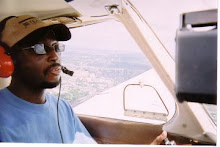
Sunday, August 8, 2010

Right into the Fire.

The first thing you need to keep in mind is that I have not flown since October, which was about nine months ago. So you know how excited I was to get back in the air after this extended period with my feet, sadly, planted on the ground.

My plane, 94400, was in the air when I arrived at the airport. And as I anticipated it needed to be fueled up after the previous student was done with his lesson. While standing by the airplane talking to the student while he was tying down, my flight instructor Mark yelled across the apron "How much hood time have you gotten so far?". I don't think he was asking me how much time I had spent in "The Hood", so the answer was zero time.

After going through the usual re-acquaintance of the airplane we were up in the air for about five minutes, not even giving me a chance to practice any turns or any other maneuvers he had put on the hood and we started boring holes in the sky with my head buried in the panel. This is where my experience with Microsoft Flight Simulator started to pay off. Keeping in mind that I was rusty for not flying all this time overall I did pretty well and was not intimidated too much, except when Mark decided to cover up the heading indicator. When Mark tried to show me how to turn to headings based on timing my turns it started to become a little overwhelming, but I was still somewhat successful. Mark also had me hold my head down and asked me to fly in different attitudes without looking at the instruments. It pretty much was a head down do not look at the panel, turn left without looking at the panel and then start to climb without looking at the panel, and then he would remove the hood and I would have to recover from these unusual attitudes. From this, I began to appreciate the need for an instrument rating and why it is very important to stay out of the clouds and what could happen if you had a partial panel when flying into clouds. We finished up with me flying to Wayne County under the hood with him talking me through the approach and then removing my lead when about 200 feet off of the ground on very short final.

We flew back to the home base in my landing actually was not bad after not flying for such a long time. What made this landing better than all of the others was that might push the was right on target, at 60 knots, and there is very little float when I flared for landing.

I decided to take an hour and a half break while Mark flew with another student and then decided to go up for some takeoffs and landings. For some reason the airplane did not want to make its descent steep enough and I ended up with three aborted landings. Now keep in mind this, I have probably aborted three landings in all of my training but today I had three in one hour. All of the landings were aborted because I was high on my approach after I turned final. Mark suggested that I would slip and lose altitude on final approach, but I felt uneasy about that because I had not performed a slip let's just say for a very very long time. So we departed the pattern and flew out to a practice area and practice a couple slips, and came back for a few more landings. After a couple of mediocre and hot landings I decided to call it a day. Even though I wanted to try a couple more landings I had to call it a day mostly due to the fact that I had consumed two large bottles of water and when you have three kidneys that water gets processed very quickly and you know what happens after that.

Next weekend is the Poker Run between four airports, and since I am due for my dual cross country this would be a great time to get it in a 200 mile, four hour cross-country instruction. We will see.

Friday, July 23, 2010

Crappy Cross Country (It was only a test)

This evening I decided to take a short cross country from one unfamiliar airport to another. This flight made me see exactly what I have forgotten over the past few months.

Well, before I get into the story, I will warn you ahead of time that this flight was on my Microsoft Flight Simulator, which also has Ultimate Terrain software. What I really like about the software is that it adds in many landmarks that the regular flight simulator does not have.

I started from Bolton airfield in Columbus and flew to route direct to Stewart Airfield which is approximately a 52 mile flight direct.

I will have to grade myself a C- due to a few mental errors. And while some will laugh or roll their eyes at simulating a flight such as this, to me and many other pilots this allows us to work on our routines and procedures such as using the check list, navigation, and get used to many procedures, many which are mandatory, and the simulator allows us to learn on the ground when it is not going to get us killed, or written up by the FAA.

I had a few minor glitches from the beginning such as not having the correct frequencies written down, but that will clear up as soon as I start using this flight planning sheets. My taxi, take off, and climb out were pretty much within guidelines and I was able to maintain the compass heading fairly well most of the flight. Also keep in mind, I am using the magnetic compass and not be directional gyro on the panel. The funny thing is that when using the magnetic compass you are always turning in the opposite direction to achieve the correct compass heading.

My first landmark pretty much was within two to three minutes, but absentmindedly I had climbed to 3500 feet as planned, but should have planned for a climb to 4500 feet due to my true course heading. Even though the 3500 foot altitude I was still legal because I was just about 2000 feet above ground I still have a cushion before I had to adhere to the even and odd altitude assignments.

My second checkpoint came a lot sooner than I figured. After I completed my flight I figured out what the problem was. Pilot error, garbage in, garbage out. After I got to my final reference point which is located about 4 miles east of the airport I had to search for the airport for a few minutes before I found it. From there, I entered a 45 into the upwind leg and everything after that pretty much was routine. And by the way, the landing was good, and the right beyond the threshold which is where I went to idle on the downwind leg.

Once I get back up in the air in a few weeks I should move right into my dual cross country.

And one final note. When my friend Steve flew up from Stewart, I was at the airport waiting for him. But when I landed at Stewart tonight on my flight simulator I expected to at least see a little animated pilot waving at me as I landed. I guess I was asking for a little too much?

Thursday, July 22, 2010

Waiting is almost over

Okay, I know that I have not blogged for a long time, but that is because I have not been flying.

I SHOULD be back up in the air in the next 2 weeks after I get back from Madison, Wisconsin, from the Transplant Games. My plan was to have my license by now and to fly up, but, as things go ...

I been in the books, and watching vids and will be taking a couple of sample written exams to get back to speed. I have to get signed off to solo again and then do my cross countries.

I MAY be switching to a friend's Piper Cherokee, and have a new instructor, but that remains to be seen. For now, 94400 is waiting for me.

Wednesday, July 21, 2010

My HERO!!

Wounded warrior gets new wings
By Dave Hirschman


Tammy Duckworth, a former U.S. Army UH-60 Black Hawk pilot severely wounded in Iraq in 2004, is now an FAA-certificated private pilot in fixed-wing aircraft.

Duckworth passed her checkride July 19 at Manassas Regional/Harry P. Davis Field in northern Virginia, and she hopes, eventually, to return to helicopter flying. Her husband, Bryan Bowlsby, is an instrument-rated private pilot.

“Tammy is a very rare person, and she was fun to teach,“ said Ben Negussie, Duckworth’s flight instructor at Dulles Aviation in Manassas. “She’s incredibly self-disciplined and hard working. She’s got a great sense of humor, and she made my job easy.”

Duckworth lost all of her right leg and most of her left when her helicopter was struck by an insurgent-fired rocket-propelled grenade. She currently serves as an officer in the Illinois National Guard but her amputations prevent her from military flying. Duckworth lives and works in Washington, D.C., where she is an assistant secretary at the federal Department of Veterans Affairs.

Monday, May 10, 2010

Medical Certificate Update

All I can say is ... GOT IT!!

Thank you Dr. Dr. Wirtz in Westlake. All of you pilots in the Cleveland area, I can vouch for this physician. Non-threatening, professional and down to earth. The staff was friendly and jovial also.

Best of all, I saved a LOT of money that translates to almost 2 hours of flying.

WOW ... as a Cleveland Clinic fan, I will have to stop bad mouthing University Hospitals.

‘It’s just a mess’

Difficult recovery ahead for Nashville airport
By Alyssa J. Miller

As Nashville residents return to their homes and offices to clean up from the recent flooding, tenants at Cornelia Fort Airpark headed to the airport May 6--not to assess the damage, but to figure out how to pick up and start over.

“It’s a loss that’s going to be hard to recover from, but we’re gonna try,” said Bill Colbert Jr., who joined the family business of running the privately owned, public-use airport 19 years ago after he retired from the military. His father has been involved with the airpark since it was founded in 1944 and has owned it since the 1950s.

The waters rose so quickly that only one of the 30 based aircraft escaped the damaging flood, but even it still had water in its tail and interior. The aircraft owner was able to move it to the highest point on the airport so that the engine at least remained out of the water.

“We did not expect it to crest at 13 feet above flood stage” at the airport, Colbert said, explaining that the airport, which is located next to the Cumberland River, has flooded before but never to this extent. “Today was the first day we were able to get back in the warehouse,” he said of the building housing the other family business, Colemill Enterprises, Inc., which offers charter services, airframe and avionics maintenance, conversions, and flight instruction.

As of May 6, other hangars on the field still had water in them, including one that housed two King Airs (at crest the water was up to the windshield on both), and the taxiway was completely submerged, but parts of the runway were starting to appear. A hill behind the Colemill building slid, causing further damage, and the airpark’s fuel tanks came loose, floating about 10 feet before coming to rest against a hangar.

The water, which rose to six to eight feet in some hangars, isn’t expected to fully recede from the airport until Saturday. Power likely won’t be restored for more than a week.

“Right now we’re just trying to get some professional companies in here to clean up,” Colbert said, “and then we’ll have to start rebuilding.”

John Mrzena, who works in the parts department at Colemill Enterprises, said the water was four to five feet deep in the parts room where he was starting the cleanup process, sanitizing tables and chairs in the office. “It’s just a mess,” he said.

Insurance brokers have started coming to the airpark to assess the aircraft where the water has receded enough. So far, all that have been inspected have been totaled.

Colbert has notified the FAA to issue a notam closing the airport. “It’s a pretty sad story,” he said. “It’s just going to take time” to clean up and reopen.


May 6, 2010
(This is where I took my first flying lesson when I was 14. This airport is on my list of places to fly to after I get my license.)

Tuesday, May 4, 2010

GROUNDED!! And it's NOT my $*&@($ Fault!

Look, I am still upset over this so I didn't post, but a few have been asking me what is going on with my flying.

Here is the latest. On April 30th, my medical expired, thanks to some person at the Cleveland Clinic. After I got my okay from the FAA to take my medical exam, I immediately called the Clinic for my exam with the (AME) Aero Medical Examiner, the same AME I took the exam with initially.

When I showed up for my exam, I was advised that I had no appointment. Upon further review, it was found that someone in the Clinic cancelled my appointment instead of cancelling my eye exam appointment. It was an admitted error of the system, a 'common occurance' when using MyChart, which is the Clinic's program that allows patients to manage their appointments and other matters on line instead of calling in.

Well, I am human and so are staff members at the Clinic. Mostly all of them are professional. An error was made, no problem. I can come next week, no harm. Well, the scheduling system was showing that he was not available until June. Now, while I have not flown in MONTHS and I am anxious to be back in the air in the next 72 hours. But the 'Scheduling Gate Keeper' had other plans.

The 'Scheduling Gate Keeper' in a professional way told me "Tough $#!*" when I told her I can not wait until June. So, even though CCF screwed this up by their own admission, I still have to wait??

I will see another AME in the next week.